
Touchline View: Why children need to play street football
Touchline View is a weekly column focused on youth football and sport in general written by Damien Hillen. Damien is a UEFA A Licence Coach, former First Team Coach at Newry City AFC, current Academy Director at Newry City AFC, and one of the founders of the Windmill Stars Youth Academy. He has seen first hand how football and sport can shape young people in terms of confidence, discipline, resilience, attitude, and ambition.
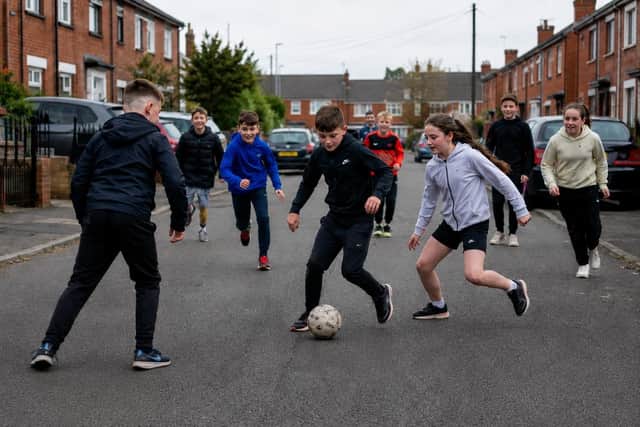

I remember when football was something kids organised themselves. A few goals made from whatever you could find lying around, or a couple of coats. A ball that was sometimes too flat, sometimes too light, and often belonged to the child who could end the game by taking it home when he was called in. The teams were rarely even. The pitch was far from perfect. The rules changed depending on who was older, who was winning or if it was getting dark. It was, noisy, competitive and brilliant fun.
You learned how to cope and play against bigger, older kids. You learned how to protect yourself and the ball, how to solve arguments, pick teams, deal with losing and work out very quickly who could be trusted with the ball. Most importantly, you played for hours. There was no coach and no ref. Nobody had to tell you to keep going. You simply did.

Today it seems that for many children, football only happens when an adult organises it. Kids may get one or two hours of coaching during the week and a match at the weekend. Outside of that, the ball disappears.
Research shows that children are spending less time playing outdoors. Parents worry about safety, traffic and of course there are the online gaming distractions. At the same time, the UK Chief Medical Officers recommend that children need at least 60 minutes of physical activity each day. A couple of football sessions a week will help, but on their own they are not enough.
From a football point of view, with less and less street football, kids have fewer touches of the ball. They spend less time dribbling, turning, shooting, tackling, and working things out for themselves. That is a concern, because so much of their development comes from time on the ball.
The FA and UEFA have both placed a strong emphasis on keeping the ball rolling, using small sided games and giving children more chances to make decisions. Long queues, long talks and over structured sessions reduce the very thing children need most, which is repetition, involvement and enjoyment.
You can usually tell which children are spending time with the ball away from training. At the younger age groups especially, it becomes clear very quickly. Their touch improves. Their balance changes. They try things. They become more comfortable receiving the ball, changing direction and recovering when something goes wrong, and the really young ones come to training to show you what they have been practicing.
This doesn’t mean they have to be out for hours every night. It doesn’t mean we should put pressure on them. Just ten minutes with a ball can make a difference if it happens often enough and the child enjoys it.
A kick about with brothers and sisters or friends all give children something different. There is no coach stopping the game. They get stuck in and get on with it.
Good coaching and safe environments matter. The point is that coaching should support a child’s love of the game, not replace it. If football only exists in coaching sessions, kids miss out on the type of play that builds confidence, creativity and resilience.
So what can we do? As coaches, we can build more free play into our sessions. Let children arrive, grab a ball and play. No queues. No long talks. Let them dribble, shoot, play one v one, two v two or make up their own game. Coaches can watch. There is a lot to learn from how children play when nobody is telling them what to do.
We can protect the time they have with the ball. Too many children still spend too long standing in lines or listening to instructions. If we only have them for an hour, the ball needs to be moving. Small sided games, quick restarts and simple challenges will teach more than long explanations.
We can give them simple challenges to try at home. Not homework. Something fun. How many keepy ups can you do? Can you practise three different turns in the garden? Can you pass against a wall and beat your own score? Can you dribble through five cones and time yourself? Challenges that are light and enjoyable.
The street game may not come back in the same way it used to exist. Life has changed, roads are busier, parents are more cautious and children have more distractions. Yet the need for it hasn’t. Children still need lots of touches of the ball. They want to play and have fun and they need football that feels like play.
If we can give them more of that, we will help more children stay active, stay involved, keep developing and enjoying the game.