
Southern Trust under pressure as outpatient waiting lists surge
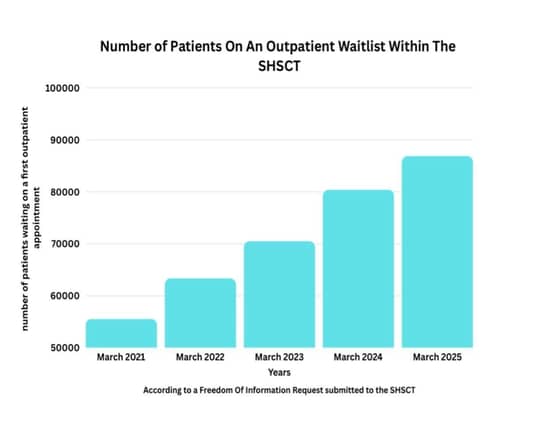

A Freedom of Information (FOI) request to the Southern Health and Social Care Trust has revealed that as of March 2025 there are approximately 88,000 patients on an outpatient waiting list within the Southern Health and Social Care Trust.
The Department of Health target for outpatients is 52 weeks. The FOI data shows that as of March 2021, one patient had the longest wait time for a first outpatient appointment at 506 weeks. This equates to almost ten times the projected waiting time.
Alliance MLA, Eóin Tennyson has said: “People in Northern Ireland are languishing on some of the worst waiting lists anywhere in western Europe, due to prolonged periods of stop-start government and a failure to adequately transform our health and social care system. At present, we have some of the highest spending per head on these islands and the worst outcomes. That is not a sustainable or acceptable position”.
Professor Mark Taylor, who is a senior surgeon, has been appointed to tackle Northern Ireland waiting lists. This is the first time someone has been appointed to tackle these waiting lists in Northern Ireland. He said that outpatient waiting times in Northern Ireland are “nothing short of a national shame” and that his team are working "tirelessly" to reduce these wait times.
An independent UK health policy think-tank, the Nuffield Trust, has said: “This sorry situation has built up gradually because the supply of care does not keep pace with people's needs. Health services in other parts of the UK and in the Republic of Ireland have also struggled to keep waits short, especially after covid-19.”
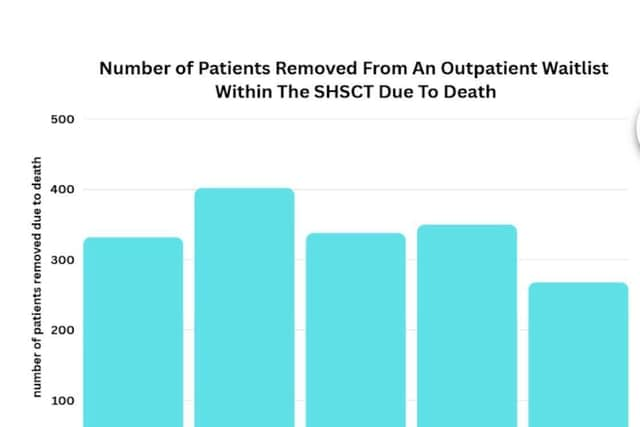
The FOI data also reveals that the number of inpatient/day-case patients who were added to a waiting list but then removed due to death was at its highest between 2021-2022, with 402 patients being removed due to death.
A spokesperson for the Southern Health and Social Care Trust said: “No assumption can be made that being on a waiting list in any way contributed to the cause of death and there are many different causes of death. No one should be waiting excessive periods of time for health service treatment, particularly those in the final chapters of their lives”.
The FOI data also revealed that there were 104 formal complaints and 175 informal complaints in respect of waiting times in the last five years.
According to the Nuffield Trust, one in twenty patients wait close to five years on an outpatient waiting list.
“Outpatient waits in Northern Ireland are unacceptably long, more or less across the board, close to a year on average even in the more fortunate specialties and close to two years in, for example, neurology.”
Staffing Pressures
Vacancies in Northern Ireland remain high. According to the Department of Health, as of September 2025, there were over 6,000 active Health and Social Care vacancies across Northern Ireland, representing a 7.3% vacancy rate. The highest number of vacancies actively being recruited across HSC was in the Nursing & Midwifery occupational family, with 2,098 vacancies.
The Department of Health also highlights that Northern Ireland’s medical and dental workforce is a little under 5,200 Whole Time Equivalent (WTE), including 2,214 consultants.
A spokesperson for the Southern Health and Social Care said: “With ongoing workforce pressures and demand for health and social care services continuing to grow beyond our capacity, regrettably, many people are waiting much longer than what we would ever want for outpatient appointments across a range of specialties”.
Finances
In May 2025 the Health Minister, Mike Nesbitt, outlined his plans to help bring down hospital waiting lists with an injection of £215m.
Mr Nesbitt said; “I have been clear that tackling hospital waiting lists will take time, determination and long term large-scale investment.”
“The initiatives set out in the Implementation and Funding Plan will make a real difference to thousands of patients who have been waiting too long for assessment and treatment.”
During a debate on cancer waiting times in the assembly, Nesbitt had confirmed that £73.5m has now been taken away from waiting list initiatives and has been allocated to the Department of Health’s £600m deficit after being questioned by DUP MLA, Diane Dodds.
She told the BBC: "it is incredible to think that money designed to tackle the most appalling waiting lists could be used in this way".
Reset Plan
According to the Northern Ireland Executive, a ‘Reset Plan’ has been set in place to reduce the waiting list times across Northern Ireland. From April 2025, more than 100 thousand red flag or time-critical patients have been seen, diagnosed or treated across Health and Social Care Trusts. This figure is expected to rise to around 200 thousand patients.
Between April and September 2025, many outpatient waiting list times have reduced, including the number of people waiting over four years for an outpatient appointment has fallen by 24%, equivalent to approximately 25,000 fewer patients.
Me Nesbitt said: “There is still a great deal of work to do, but these results demonstrate that when we focus our efforts, work collaboratively across the system, and make best use of all available capacity, we can make a real difference. This is about building a health service that delivers timely care for everyone.”
“Professor Taylor’s leadership and the dedication of staff across our health service are central to this progress. We are changing how services work, clearing the longest waits, and building the foundations for a more sustainable system.”
Tennyson believes the Health Minister’s blueprint for transformation “lacks a meaningful roadmap and detail on exactly how reform of services will be delivered”.
The Nuffield Trust suggests the situation “is not going to be addressed quickly: it requires a prolonged drive on productivity with greater transparency, a willingness to learn from others, and some real political bravery about centralising some services as recent governments have made tentative steps towards doing.”